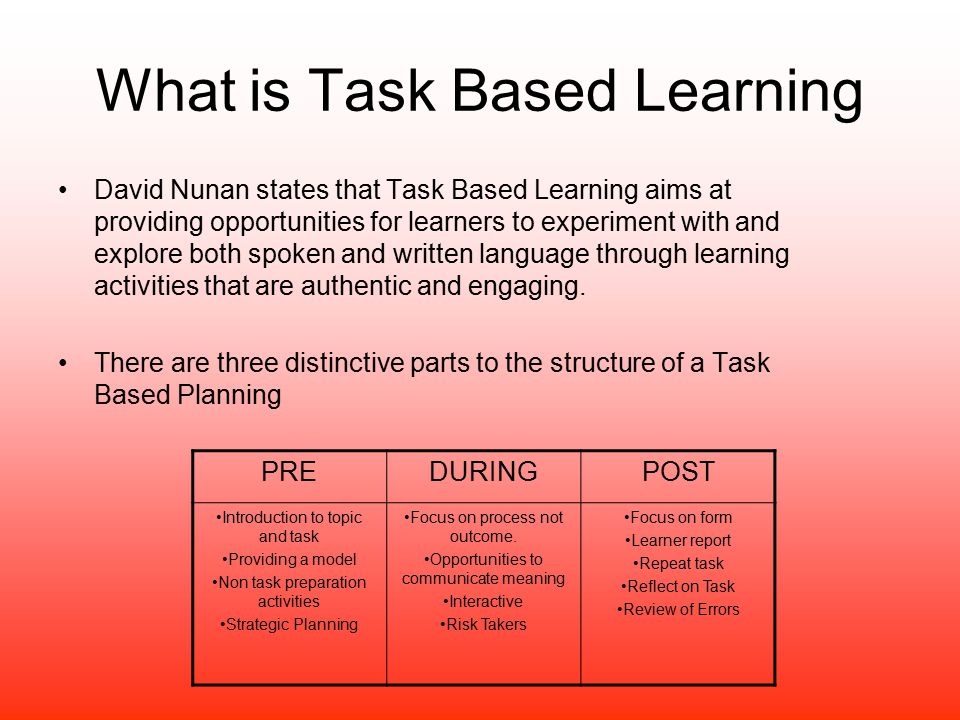
1) CONSTRUCTION OF DIAGRAMS / PRE-TASKING: Introduce the topic, context, vocabulary and expressions.
2) LISTEN: Analysis of the linguistic elements involved in the task (morphology, syntax, vocabulary, phonetics).
2. CONTROLLED PRACTICE: Similar to a traditional or audiolingual lesson. Practice of vocabulary, structures and functions, but connected with the communicative context.
4. LANGUAGE EXERCISES: Intensive practice of listening and video comprehension related to the communicative functions involved in the final task.
5. FREE PRACTICE: The controlled and reproductive practice is left behind by free oral and written production activities: role-playing,...
6) PEDAGOGICAL TASK: The pedagogical task presented at the beginning of the sequence is carried out.
Sunday, 7 April 2019

Task-Based Learning: Activities
Tasks: context-centred + communicative skills
1) Simulations: recreation of real actions.
2) Limit situations: forced activation.
Exercises: focused on language + language skills
1) Focused: manipulation of structures.
2) Contextualized: structures in a communicative context.
1) Simulations: recreation of real actions.
2) Limit situations: forced activation.
Exercises: focused on language + language skills
1) Focused: manipulation of structures.
2) Contextualized: structures in a communicative context.
Task-Based Learning: What is a task?
Rod Ellis:
"Task is a workplan, involves a primary focus on meaning, involves real-world processes of language use, can involve any of the four language skills, engages cognitive processes, has a clearly defined communicative outcome"
A task...
1) Has one purpose: to learn L2 as users of it.
2) Has a perspective: it is a work plan aimed at involving the student in the use of meaning-centred L2.
3) It is authentic: it is a meaningful recreation of habitual or daily activities.
4) Mobilises skills: generally linguistic (oral).
5) Mobilizes cognitive processes: tasks can be cognitively more or less complex.
6) Produces a result: the task must produce a concrete result with linguistic content in L2.
"Task is a workplan, involves a primary focus on meaning, involves real-world processes of language use, can involve any of the four language skills, engages cognitive processes, has a clearly defined communicative outcome"
A task...
1) Has one purpose: to learn L2 as users of it.
2) Has a perspective: it is a work plan aimed at involving the student in the use of meaning-centred L2.
3) It is authentic: it is a meaningful recreation of habitual or daily activities.
4) Mobilises skills: generally linguistic (oral).
5) Mobilizes cognitive processes: tasks can be cognitively more or less complex.
6) Produces a result: the task must produce a concrete result with linguistic content in L2.
The 7 principles of Task-Based learning
1. Integration: the form, meaning and communicative function of
the items are learned in an integrated way.
2. Active
learning: students learn an L2 best when they use it by performing a
meaningful action.
3.
Dependence between tasks: a task is built on the previous ones in a
progression.
4. From
reproduction to creation: students should progress from reproduction in L2
to creation in L2.
5.
Scaffolding: support learning, understanding, production
6.
Linguistic recycling: linguistic elements must appear in several tasks to
be learned.
7.
Reflection: students should reflect on their learning and results.
Foreign Language Teaching Methodologies: Task-Based Learning
Time frame: 2000
CECRL (Cadre européen commun de référence pour les langues)
Aim: perform significant tasks in order to acquire language skills.
Baseline theories: Canale and Swain (80s), Bachnan (90s).
Students:
learn how to learn + responsible for their own learning + self-reliant and aware of their own learning
the student is the centre of the learning process
Teacher:
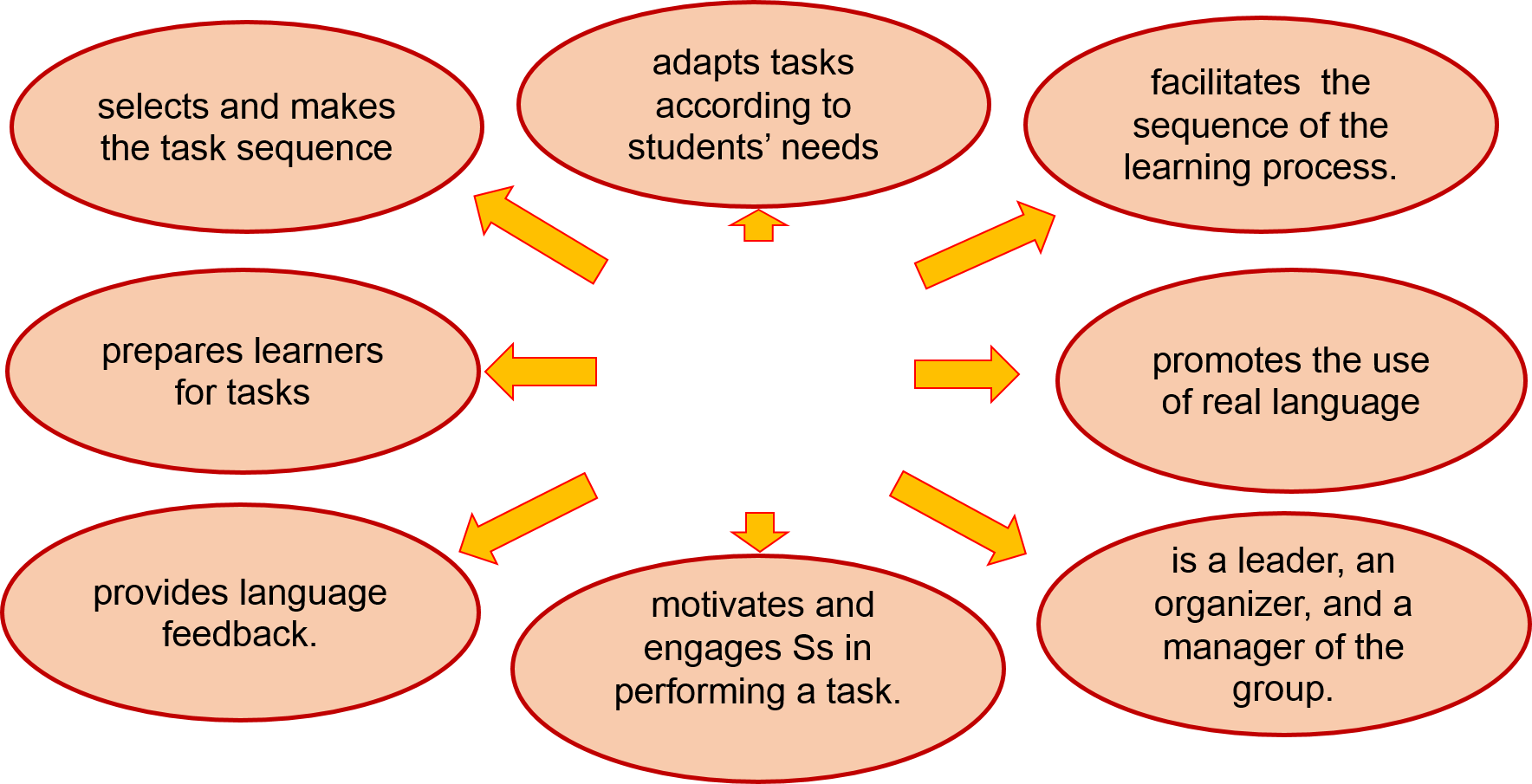
a guide who supports and encourages learning (motivation) + provides feedback
Teaching-learning process:
acquisition of skills and strategies + prioritization of oral language + discovery of vocabulary and grammar + authentic or pedagogized materials + group learning (socioconstructivism)
work levels: micro-tasks + meaningful activities (games, simulations...) + final task (genealogical tree, recipe book...)
Phases of the teaching and learning process:
1) Reception (input) phase: listening, reading...
2) Production phase (output): repetition of dialogues, questions/answers...
3) Interactive phase: resolution of the task.
Activities:
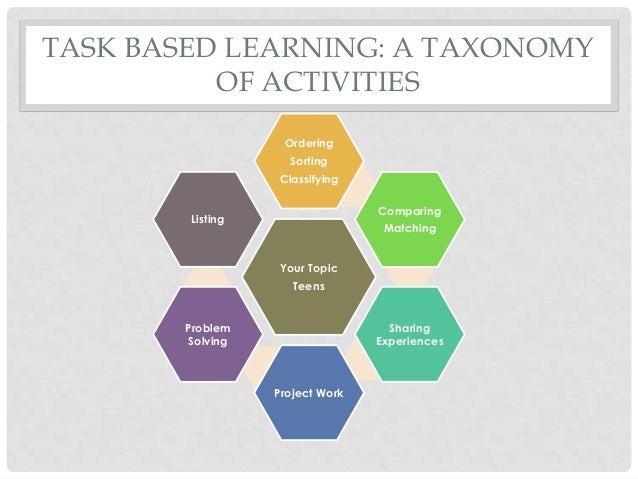
1) Pedagogical classification: drawing up lists, sorting and classifying, comparing and finding differences, solving problems, sharing personal experiences, performing creative tasks...
2) Psycholinguistic classification: puzzles, drills, problem solving, decision making, exchange of opinions...

CECRL (Cadre européen commun de référence pour les langues)
Aim: perform significant tasks in order to acquire language skills.
Baseline theories: Canale and Swain (80s), Bachnan (90s).
Students:
learn how to learn + responsible for their own learning + self-reliant and aware of their own learning
the student is the centre of the learning process
Teacher:
a guide who supports and encourages learning (motivation) + provides feedback
Teaching-learning process:
acquisition of skills and strategies + prioritization of oral language + discovery of vocabulary and grammar + authentic or pedagogized materials + group learning (socioconstructivism)
work levels: micro-tasks + meaningful activities (games, simulations...) + final task (genealogical tree, recipe book...)
Phases of the teaching and learning process:
1) Reception (input) phase: listening, reading...
2) Production phase (output): repetition of dialogues, questions/answers...
3) Interactive phase: resolution of the task.
Activities:
1) Pedagogical classification: drawing up lists, sorting and classifying, comparing and finding differences, solving problems, sharing personal experiences, performing creative tasks...
2) Psycholinguistic classification: puzzles, drills, problem solving, decision making, exchange of opinions...
Foreign Language Teaching Methodologies: Communicative
Early 1970s
Aim: learn how to communicate in everyday situations
Baseline theories:
1) Linguistics: sociolinguistics (Hymes) and pragmatics.
2) Psychology: cognitivism (Austin, Searle).
Approaches:
1) English situational methodology:
behaviouralism -> automatisms
oral approach + explicit grammar
2) Communicative approach:
communicative situations (70s-80s)
priority of oral language + quick introduction to writing + teacher as animator + audio and video (pedagogized) + dialogues in situation (vocabulary, structures, simulation) + explicit grammar
3) Functional-notional approach:
70s-90s
aim pedagogy + focused on the needs of the students + teacher as animator, designer and evaluator

Aim: learn how to communicate in everyday situations
Baseline theories:
1) Linguistics: sociolinguistics (Hymes) and pragmatics.
2) Psychology: cognitivism (Austin, Searle).
Approaches:
1) English situational methodology:
behaviouralism -> automatisms
oral approach + explicit grammar
2) Communicative approach:
communicative situations (70s-80s)
priority of oral language + quick introduction to writing + teacher as animator + audio and video (pedagogized) + dialogues in situation (vocabulary, structures, simulation) + explicit grammar
3) Functional-notional approach:
70s-90s
aim pedagogy + focused on the needs of the students + teacher as animator, designer and evaluator
Foreign Language Teaching Methodologies: MAO-MAV
1960s MAO in the United States
Aim: learn to understand, speak, read and write.
Baseline theories:
1) Structuralism (linguistics): Bloomfield (language as system/structure).
2) Behavioralism (psychology): Skinner (stimulation - response - reinforcement).
Teacher:
Linguistic knowledge.
Runs the classrooms.
Possesses technical knowledge and skills.
Materials: CDs, cassettes, slides and transparencies.
Oral language learning + foreign language + learning of linguistic structures
Memorization and repetition of structures + structured exercises -> Grammar
Gradual progression (meaning is not the most important thing).
Pedagogical dialogues (audios) and structural exercises (drills).


Aim: learn to understand, speak, read and write.
Baseline theories:
1) Structuralism (linguistics): Bloomfield (language as system/structure).
2) Behavioralism (psychology): Skinner (stimulation - response - reinforcement).
Teacher:
Linguistic knowledge.
Runs the classrooms.
Possesses technical knowledge and skills.
Materials: CDs, cassettes, slides and transparencies.
Oral language learning + foreign language + learning of linguistic structures
Memorization and repetition of structures + structured exercises -> Grammar
Gradual progression (meaning is not the most important thing).
Pedagogical dialogues (audios) and structural exercises (drills).
1950s-60s SGAV in Europe
Reformulation of the Mao-Mav methodology -> Chomsky (linguistics) + Gestalt (psychology).
Communication situations (situational context)
Image and sound: Decryption images (semantic content) + Situational images (communication situations).
Foreign Language Teaching Methodologies: Active
Is born out of the crisis of direct methodology (1920-1960).
Middle ground between the traditional and the modern:
L1 and written texts and explicit grammar + oral language and dialogue

Foreign Language Teaching Methodologies: Direct
Emerges at the end of the 19th century - beginning of the 20th century (1902- pedagogical coup d'état in France).
Main target/aim: learn to speak in an active and global way.
Theory based: François Gouin + learning theories (psychology).
Teacher: leads the class, possesses all the knowledge.
Priority to oral language learning and exclusive use of the foreign language.
Phonetics and pronunciation.
Dialogues + written materials.
Main target/aim: learn to speak in an active and global way.
Theory based: François Gouin + learning theories (psychology).
Teacher: leads the class, possesses all the knowledge.
Priority to oral language learning and exclusive use of the foreign language.
Phonetics and pronunciation.
Dialogues + written materials.
Foreign Language Teaching Methodologies: Traditional
Its main aim was to facilitate access to literary texts.
Elitist conception of teaching (high social classes).
Learning was teacher-centred (vertical transmission of linguistic knowledge).
Predominance of written language learning.
Grammar and translation activities (explicit and traditional grammar).
L1 was predominantly used.
Materials: grammars, dictionaries, literary texts.

Wednesday, 16 January 2019
Monday, 14 January 2019
CLIL & EFL
CLIL is an integrated process, a methodology for language teaching. It is based on certain methodological principles that are particularly important according to research in the didactics of foreign languages, such as the need for the learner to be placed in a situation of authentic communication. On the other hand we must introduce the concept of EFL which is the didactics of the foreign language.
EFL
|
CLIL
| |
Who teaches?
|
The language teacher (foreign)
|
The teacher of a non-linguistic subject
|
What is the objective?
|
Teaching/learning a foreign language
|
Teaching non-linguistic content
|
What do they teach?
| Pronunciation, grammar, vocabulary... |
Mathematics, natural sciences, music, history...
|
Who does the teacher work with?
|
With other teachers of the same language
|
With the foreign language teacher
|
What are we evaluating?
|
Language skills and knowledge
|
Skills and knowledge of a subject but sometimes also of LE
|
What feedback is provided by the teacher?
|
Linguistic feedback
|
Feedback on the material and sometimes on the LE
|
TYPES OF CLIL
1) Hard CLIL is focused on the subject which is/are taught entirely in L2 (30% of the maximum annual hours)
2) Medium CLIL is focused on the subject (partial immersion) which is taught in L2 (just part of the subject not all of it) and only 1 hour per week (15 hours per semester).
3) Soft CLIL is content focused (focused on L2), a non-linguistic content taught in the L2 subject area (45 minutes per week).
Thursday, 1 November 2018
Information and Communication Technologies (ICTs)
Nowadays, it is impossible to conceive education without the implementation of the Information and Communication Technologies (ICTs). For this reason, in the last session the teacher showed us a few resources we could use in the future which are:
• Applications for character designing: Ifunface, Muglife, Snapchat, Talkr... Creating a commendable character to explain some contents helps promoting significative learning. This kind of tool it's not only useful for the teacher but also for the students who can apply it in the making of presentations.
• Genially: It allows you to create infograms, slides, interactive murals, graphics, tests, maps, audio, video, gifs, timelines, animations... It is a very useful tool to perform interactive activities.
• Thinklink: Similar to Genially but easier, it is appropriate for designing presentations with different links attached to videos, tests, songs...
• Microphone and tripod for mobile phones: allows you to record students' speeches and presentations in video or just audio.
Scaffolding 3: more techniques
Other methodological strategies used in language learning are:
• Slow down speeches and oral expressions paired with appropriate gestures.
• Repeat structures doing emphasis in problematic parts with pronounced intonation.
• Take advantage of students feedback to redirect the speech.
• Use visual organisers to accompany and complete the explanations (schemes, mind maps, Ishikawa diagram, videos...).
• Communicative schemes and grammatical structures.
• Error correcting codes.
• Total Physical Response (TPR):
Students internalize and understand the meaning of words and grammatical structures trough the repetition of different movements and gestures that the teacher perform. Thereby, the learning and comprehension of the nouns, verbs, adjectives, adverbs... becomes more dynamic, intuitive and easier. This is a key technique in the first years of children's education where reading and writing isn't developed yet.
• Storytelling techniques:
This refers to the use of stories or tales to communicate complex information in a more dynamic and motivational way. Storytelling appears as a useful tool to teach abstract concepts and ideas, introducing connections between them and students' interest and context.
Tuesday, 30 October 2018
Scaffolding 2: techniques
In the last session we addressed the diverse Scaffolding techniques differentiating between three main categories which are production, understanding and general techniques. Likewise, we also collected some techniques and, first in small groups and then collectively, we classified them in those three categories. Thereby, we now have a substantial amount of techniques properly classed that we submit in this very post and that could help us in the development and designing of our project.
Production techniques:
• Play videos or suggest readings before activities where you have to talk or write.
• Specify what students should say or write and how they should do it.
•Brainstorm what can be said and written and then organize ideas with a visual organizer.
• Give students patterns of language structures that they can use both orally and in writing.
• Ask students to think about the grammar and vocabulary they need to make a presentation or to write a text.
• Allow the use of dictionaries during the preparation of drafts or presentations.
General techniques:
• Promote reflection in small groups on what has just been done.
• Use L1 in activation activities with beginner students in L2.
• Encourage collaborative work so that students can help each other.
• Provide activation activities.
• Encourage students to ask questions about the activities to be done.
• Help students make connections with activities they have already done.
• Provide feedback to students on their progress.
• Provide examples for activities to be done.
• Repeat essential ideas or key words during an explanation.
• Split activities into different steps or parts.
• Simplify the language used.
• Use images or visual organizers to illustrate or synthesize the contents of a text.
• Speak slowly and clearly.
Understanding techniques:
• Present the context of the texts to be read or listened to.
• Provide visual organizers for students to take notes on what they hear or read in a more organized way.
• Ask learners questions to avoid misunderstandings.
• Ask students to note or underline the key vocabulary of a video or text.
• Suggest that students predict what they will see, hear or read.
• Use gestures to illustrate the meanings of an oral message.
Scaffolding 1: concept
Scaffolding has been a recurrent key concept in the subject lessons. This term have its origin in Vygotsky's concept of Zone of Proximal Development (ZPD) which is, in essence, the difference between what a learner can achieve without help and what he/she can't do. This refers to the distance that exist between the actual psychic development of an individual and her/his potential development.

Vygostksy distinguishes among Zone of Real Development, which covers the level of a task that one individual can resolve independently and the Zone of Potential Development, which is the level that one individual can achieve with an expert's assistance. Therefore, Zone of Proximal Development embraces the space where, due to the interaction and help of others, one individual can resolve a problem that he/she wouldn't be able to figure out by himself/herself.
The Scaffolding is simply the elaboration and implementation by and expert of a necessary construction to accomplish the resolution of a particular task by a student. This Scaffolding must be adjustable and might have temporary nature to allow its removal once the student integrates a certain activity in his/her Zone of Real Development.
An example of this strategy, that can be applied in our field of study, could be to provide a certain vocabulary through a small bunch of words or a group of verbs that we are interested in working on and then order students to write down 3 to 5 phrases using, at least, 3 words in each phrase.
CLIL Activities: learning sequene
To reinforce our CLIL knowledge and with the principal objective of providing a guideline, the teacher reviewed the classic CLIL activity sequence during our second session. Even if it is nothing new for us it's always convenient to address key concepts.
The learning sequence in ClIL activities consist on 6 stages, that we must relate to Bloom's Taxonomy when designing our own activities, which are:
The learning sequence in ClIL activities consist on 6 stages, that we must relate to Bloom's Taxonomy when designing our own activities, which are:
1) Activation: Remember and retrieve useful knowledge (student's prior conceptions).
2) Understanding: Submit information in L2 helping the comprehension process.
3) Vocabulary: Work the basic (BICS) and specific (CALPS) vocabulary.
4) Oral production: Speak in L2 addressing different learning content.
5) Written production: Write in L2 addressing different learning content.
6) Assessment: Reflect on the learning process and its results.
6) Assessment: Reflect on the learning process and its results.
As we already know, it could be more than a task for every stage. Nevertheless the sequence must not vary. We also could segment the content we are going to handle in order to accomplish a learning process more dynamic and intuitive for our students and that is precisely what we are going to do with our sound qualities project.
We have 4 different qualities that require an specific understanding of their characteristics so, it is pretty obvious that we will need to make a segmentation of content. This will require more work on our side but we are willing to confront it with drive and positivity.
Finally, to end this post, it is necessary to clarify that even though we are going to segment the learning sequence, it will not cover the final assessment. This is merely because, in order to evaluate our students, it is needed for us to watch them distinguish between the 4 sound qualities.
We have 4 different qualities that require an specific understanding of their characteristics so, it is pretty obvious that we will need to make a segmentation of content. This will require more work on our side but we are willing to confront it with drive and positivity.
Finally, to end this post, it is necessary to clarify that even though we are going to segment the learning sequence, it will not cover the final assessment. This is merely because, in order to evaluate our students, it is needed for us to watch them distinguish between the 4 sound qualities.
Project: design a CLIL sequence
The first problem we faced was choosing a suitable content from the Primary Education curriculum. We often found that we want to cover more ground than what we really need or what we are really capable to handle, which is what exactly happened this time around. However, once we restructured our initial thoughts, we were ready to start designing our activities within our field, which is music. After several considerations, we have finally chosen fifth grade as the course where we are going to conduct our project (CLIL sequence).
The elements we chose from the curriculum (music area) are the following:
Content:
B1.3. Recognize the sound qualities: pitch, intensity, duration and timbre.
Assessment criteria:
B1.2. Identify and describe musical elements and sound qualities characteristics within an specific context.
Learning standards:
EMB1.2.1. Describe and provide information about musical language elements found in the musical manifestations and in the sounds of the context.
Competences:
CCEC
CCL
Overall aims:
j) Apply different performances and artistic forms and take the first steps in the construction of audiovisual proposals.
h) Know the fundamental aspects of natural science, social science, geography, history and culture, with special attention to those related and linked to Galicia.
h) Know the fundamental aspects of natural science, social science, geography, history and culture, with special attention to those related and linked to Galicia.
Monday, 29 October 2018
The benefits of a bilingual brain
One of our classmates shared this fascinating video trough our facebook group that shows the benefits involved in the learning of other languages.
The principal profit that almost everyone knows, or at least has heard about, it's the cultural and social enrichment. Knowing other languages provides us a wider and richer vision of the multicultural world we live in through the awareness of the different ways of understanding and appreciating our reality.
However, bilingualism is quite beneficial for our brain health too as it decrease the risk of contract degenerative diseases like dementia. A bilingual brain will have higher density due to an increase of grey matter as it will augment synapse activity in certain regions.
In regards to what we have been discussing here, we have also found a blog under the name of "Bilinguex" that provides several resources for language learning. You can check it right here:
Subscribe to:
Posts (Atom)
-
Time frame: 2000 CECRL (Cadre européen commun de référence pour les langues) Aim: perform significant tasks in order to acquire languag...
-
CLIL is an integrated process, a methodology for language teaching. It is based on certain methodological principles that are particular...
-
1. Integration: the form, meaning and communicative function of the items are learned in an integrated way. 2. Active lea...

