1) CONSTRUCTION OF DIAGRAMS / PRE-TASKING: Introduce the topic, context, vocabulary and expressions.
2) LISTEN: Analysis of the linguistic elements involved in the task (morphology, syntax, vocabulary, phonetics).
2. CONTROLLED PRACTICE: Similar to a traditional or audiolingual lesson. Practice of vocabulary, structures and functions, but connected with the communicative context.
4. LANGUAGE EXERCISES: Intensive practice of listening and video comprehension related to the communicative functions involved in the final task.
5. FREE PRACTICE: The controlled and reproductive practice is left behind by free oral and written production activities: role-playing,...
6) PEDAGOGICAL TASK: The pedagogical task presented at the beginning of the sequence is carried out.
Showing posts with label activities. Show all posts
Showing posts with label activities. Show all posts
Sunday, 7 April 2019

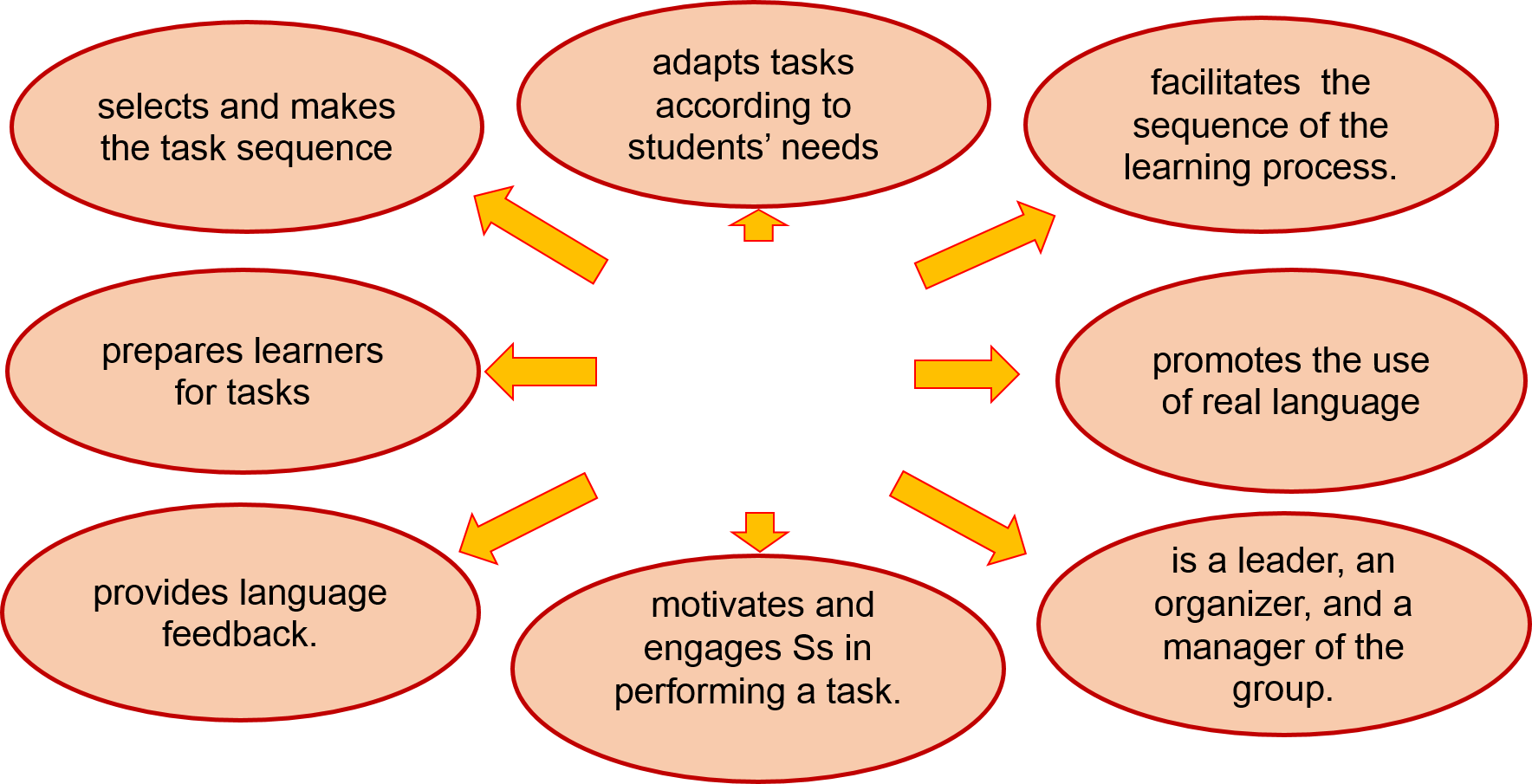
Task-Based Learning: Activities
Tasks: context-centred + communicative skills
1) Simulations: recreation of real actions.
2) Limit situations: forced activation.
Exercises: focused on language + language skills
1) Focused: manipulation of structures.
2) Contextualized: structures in a communicative context.
Wednesday, 16 January 2019
Thursday, 1 November 2018
Information and Communication Technologies (ICTs)
Nowadays, it is impossible to conceive education without the implementation of the Information and Communication Technologies (ICTs). For this reason, in the last session the teacher showed us a few resources we could use in the future which are:
• Applications for character designing: Ifunface, Muglife, Snapchat, Talkr... Creating a commendable character to explain some contents helps promoting significative learning. This kind of tool it's not only useful for the teacher but also for the students who can apply it in the making of presentations.
• Genially: It allows you to create infograms, slides, interactive murals, graphics, tests, maps, audio, video, gifs, timelines, animations... It is a very useful tool to perform interactive activities.
• Thinklink: Similar to Genially but easier, it is appropriate for designing presentations with different links attached to videos, tests, songs...
• Microphone and tripod for mobile phones: allows you to record students' speeches and presentations in video or just audio.
Scaffolding 3: more techniques
Other methodological strategies used in language learning are:
• Slow down speeches and oral expressions paired with appropriate gestures.
• Repeat structures doing emphasis in problematic parts with pronounced intonation.
• Take advantage of students feedback to redirect the speech.
• Use visual organisers to accompany and complete the explanations (schemes, mind maps, Ishikawa diagram, videos...).
• Communicative schemes and grammatical structures.
• Error correcting codes.
• Total Physical Response (TPR):
Students internalize and understand the meaning of words and grammatical structures trough the repetition of different movements and gestures that the teacher perform. Thereby, the learning and comprehension of the nouns, verbs, adjectives, adverbs... becomes more dynamic, intuitive and easier. This is a key technique in the first years of children's education where reading and writing isn't developed yet.
• Storytelling techniques:
This refers to the use of stories or tales to communicate complex information in a more dynamic and motivational way. Storytelling appears as a useful tool to teach abstract concepts and ideas, introducing connections between them and students' interest and context.
Tuesday, 30 October 2018
Scaffolding 2: techniques
In the last session we addressed the diverse Scaffolding techniques differentiating between three main categories which are production, understanding and general techniques. Likewise, we also collected some techniques and, first in small groups and then collectively, we classified them in those three categories. Thereby, we now have a substantial amount of techniques properly classed that we submit in this very post and that could help us in the development and designing of our project.
Production techniques:
• Play videos or suggest readings before activities where you have to talk or write.
• Specify what students should say or write and how they should do it.
•Brainstorm what can be said and written and then organize ideas with a visual organizer.
• Give students patterns of language structures that they can use both orally and in writing.
• Ask students to think about the grammar and vocabulary they need to make a presentation or to write a text.
• Allow the use of dictionaries during the preparation of drafts or presentations.
General techniques:
• Promote reflection in small groups on what has just been done.
• Use L1 in activation activities with beginner students in L2.
• Encourage collaborative work so that students can help each other.
• Provide activation activities.
• Encourage students to ask questions about the activities to be done.
• Help students make connections with activities they have already done.
• Provide feedback to students on their progress.
• Provide examples for activities to be done.
• Repeat essential ideas or key words during an explanation.
• Split activities into different steps or parts.
• Simplify the language used.
• Use images or visual organizers to illustrate or synthesize the contents of a text.
• Speak slowly and clearly.
Understanding techniques:
• Present the context of the texts to be read or listened to.
• Provide visual organizers for students to take notes on what they hear or read in a more organized way.
• Ask learners questions to avoid misunderstandings.
• Ask students to note or underline the key vocabulary of a video or text.
• Suggest that students predict what they will see, hear or read.
• Use gestures to illustrate the meanings of an oral message.
Scaffolding 1: concept
Scaffolding has been a recurrent key concept in the subject lessons. This term have its origin in Vygotsky's concept of Zone of Proximal Development (ZPD) which is, in essence, the difference between what a learner can achieve without help and what he/she can't do. This refers to the distance that exist between the actual psychic development of an individual and her/his potential development.

Vygostksy distinguishes among Zone of Real Development, which covers the level of a task that one individual can resolve independently and the Zone of Potential Development, which is the level that one individual can achieve with an expert's assistance. Therefore, Zone of Proximal Development embraces the space where, due to the interaction and help of others, one individual can resolve a problem that he/she wouldn't be able to figure out by himself/herself.
The Scaffolding is simply the elaboration and implementation by and expert of a necessary construction to accomplish the resolution of a particular task by a student. This Scaffolding must be adjustable and might have temporary nature to allow its removal once the student integrates a certain activity in his/her Zone of Real Development.
An example of this strategy, that can be applied in our field of study, could be to provide a certain vocabulary through a small bunch of words or a group of verbs that we are interested in working on and then order students to write down 3 to 5 phrases using, at least, 3 words in each phrase.
CLIL Activities: learning sequene
To reinforce our CLIL knowledge and with the principal objective of providing a guideline, the teacher reviewed the classic CLIL activity sequence during our second session. Even if it is nothing new for us it's always convenient to address key concepts.
The learning sequence in ClIL activities consist on 6 stages, that we must relate to Bloom's Taxonomy when designing our own activities, which are:
1) Activation: Remember and retrieve useful knowledge (student's prior conceptions).
2) Understanding: Submit information in L2 helping the comprehension process.
3) Vocabulary: Work the basic (BICS) and specific (CALPS) vocabulary.
4) Oral production: Speak in L2 addressing different learning content.
5) Written production: Write in L2 addressing different learning content.
6) Assessment: Reflect on the learning process and its results.
As we already know, it could be more than a task for every stage. Nevertheless the sequence must not vary. We also could segment the content we are going to handle in order to accomplish a learning process more dynamic and intuitive for our students and that is precisely what we are going to do with our sound qualities project.
We have 4 different qualities that require an specific understanding of their characteristics so, it is pretty obvious that we will need to make a segmentation of content. This will require more work on our side but we are willing to confront it with drive and positivity.
Finally, to end this post, it is necessary to clarify that even though we are going to segment the learning sequence, it will not cover the final assessment. This is merely because, in order to evaluate our students, it is needed for us to watch them distinguish between the 4 sound qualities.
Project: design a CLIL sequence
The first problem we faced was choosing a suitable content from the Primary Education curriculum. We often found that we want to cover more ground than what we really need or what we are really capable to handle, which is what exactly happened this time around. However, once we restructured our initial thoughts, we were ready to start designing our activities within our field, which is music. After several considerations, we have finally chosen fifth grade as the course where we are going to conduct our project (CLIL sequence).
The elements we chose from the curriculum (music area) are the following:
Content:
B1.3. Recognize the sound qualities: pitch, intensity, duration and timbre.
Assessment criteria:
B1.2. Identify and describe musical elements and sound qualities characteristics within an specific context.
Learning standards:
EMB1.2.1. Describe and provide information about musical language elements found in the musical manifestations and in the sounds of the context.
Competences:
CCEC
CCL
Overall aims:
j) Apply different performances and artistic forms and take the first steps in the construction of audiovisual proposals.
h) Know the fundamental aspects of natural science, social science, geography, history and culture, with special attention to those related and linked to Galicia.
Monday, 29 October 2018
Bloom's Taxonomy
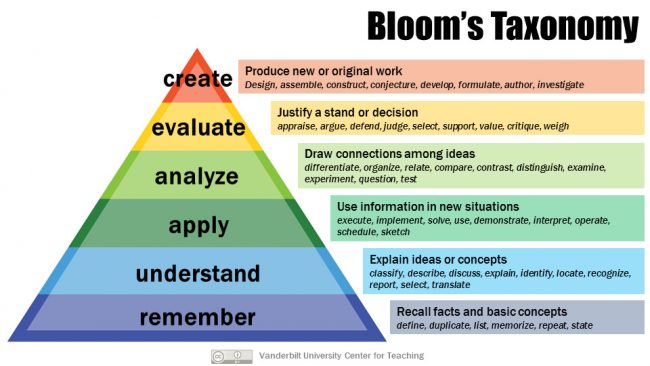
In one sentence, Bloom's Taxonomy is a classification of cognitive skills that help teachers to design and conduct the teaching/learning process. It was design by Benjamin Bloom and terminated in 1956 and its principal objective is lead students to achieve new skills and knowledge.
Constructed with the purpose of assuring a significative learning, it consists in a range of levels which are: remember, understand, apply, analyse, evaluate and create. In fact, any methodology which is based in Bloom's Taxonomy pretends for the students to develop cognitive skills that allows them to use the knowledge they acquire as a tool in the resolution of any future problem. Therefore this is an essential and useful tool for teachers all around as it can be applied to almost anything because it simply provides an order for cognitive behaviour.
Bloom's Taxonomy will be our index in the design and construction of the CLIL sequence which shall be planned according to this cognitive sequence. Every activity will force us to select suitable verbs that match our objectives in order to achieve a specific purpose. In consequence it is entirely in our hands to identify the cognitive actions that students will apply in every task and collect them properly adapting our programming to benefit its acquisition.
Subscribe to:
Posts (Atom)
-
1. Integration: the form, meaning and communicative function of the items are learned in an integrated way. 2. Active lea...
-
As we already know, CLIL stands for Content and Language Integrated Learning, a way of teaching subjects to students in a language that isn...


